Industry: Pharmaceutical and Healthcare Category: Peptide Industry News Market: United States; Global Key Topics: FDA Peptide Regulation; Pharmacy Compounding; Peptide Safety; Clinical Evidence; Regulatory Oversight Peptides Discussed: BPC-157; KPV; GHK-Cu; TB-500; MOTS-c; Semax; Epitalon; SS-31; MT-I/II; Thymosin Alpha-1 Related Areas: Anti-Aging; Sports Recovery; Bodybuilding; Longevity Clinics; Peptide Research Key Concerns: Clinical Evidence; Product Purity; Contamination; Adverse Reactions; Conflicts of Interest Company: Suprepharmagroup
News

FDA Peptide Vote Sparks Debate: Regulatory Progress, Scientific Evidence and Safety Concerns

2026-11-11 0 Leave me a message

FDA Peptide Vote Sparks Debate: Regulatory Progress, Scientific Evidence and Safety Concerns


Good news has emerged from the bodybuilding community.

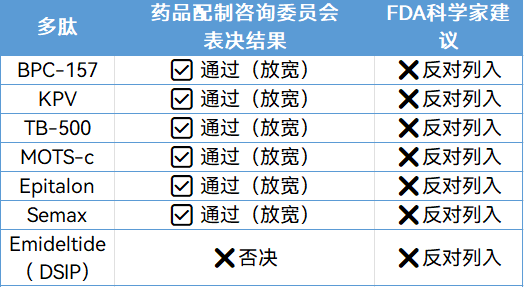
In July 2026, the U.S. Food and Drug Administration's (FDA) Pharmacy Compounding Advisory Committee voted by a narrow margin to recommend easing restrictions on six peptides, potentially allowing pharmacies to use them in compounded medications.

For people in bodybuilding, sports and anti-aging communities, the news was enough to generate considerable excitement. Injections reportedly capable of repairing tendons, reducing abdominal fat and reversing aging may have moved one step closer to a legitimate regulatory pathway.

But what exactly are these peptides? Why are they attracting so much attention in the United States? And what does this development mean for the wider market?

We examine five key questions.

1. What Are These Peptides?


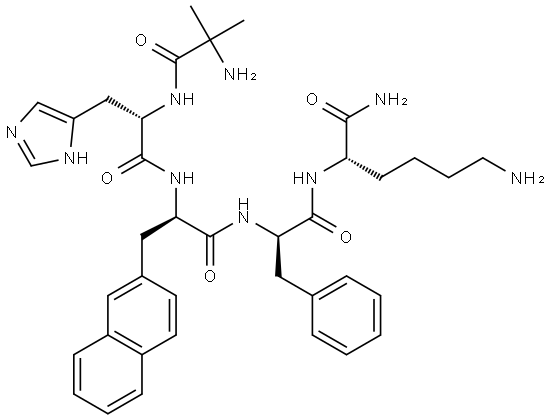
If you have heard of GLP-1 weight-loss drugs or insulin, you are already familiar with peptides. At their most basic level, peptides are chains of amino acids linked together.Note: "Peptides" is generally translated into Chinese as peptides or polypeptides. However, some compounds discussed in this article, including KPV (a tripeptide), GHK-Cu (a tripeptide), Epitalon (a tetrapeptide) and SS-31 (a tetrapeptide), are more precisely classified as oligopeptides. For simplicity, this article uses the broader term "peptides" throughout.Insulin is one of the oldest peptide-based medicines, while human growth hormone is a major pharmaceutical product with annual sales reaching billions of dollars. GLP-1 drugs, a class of peptides used to treat diabetes and obesity, generated approximately USD 51.8 billion in global sales in 2024.

These products have undergone extensive clinical testing and are established medicines.

The peptides considered in the latest FDA advisory committee vote, however, are different. They are not FDA-approved drugs. People have been obtaining them through unofficial online channels, black-market suppliers and longevity clinics, often using them for purported anti-aging benefits, physical recovery, improved sleep and enhanced cognitive performance.

2. What Does the Vote Mean for the United States?


The phrase "one step closer" suggests a positive development, but it does not mean these peptides are now legal or approved for general use.

First, the committee's recommendations are not legally binding.

The recommendations came from the FDA's Pharmacy Compounding Advisory Committee (PCAC), an external advisory body. Its recommendations do not bind the FDA, which must make its own independent regulatory decisions.

Historically, however, the FDA has rarely rejected recommendations of this kind.

In practical terms, a favorable advisory committee recommendation means that these peptides may have moved closer to a potential regulatory pathway.

Second, permission for compounding does not mean approval for commercial marketing.

Under the U.S. system, pharmacies can do more than dispense commercially manufactured medicines. Under certain legal conditions, they can also prepare customized medications for individual patients using specified ingredients.

If these peptides are eventually included on the relevant compounding list, qualifying pharmacies may be permitted to use them in compounded preparations, subject to applicable requirements.

That is not the same as authorizing unrestricted use by the general public. Nor does it mean the substances have been approved as medicines. They would still lack the extensive safety and efficacy evidence normally required for drug approval, a process that can take many years.

Nevertheless, this advisory committee vote represents a significant development for the peptide market. Pharmacies, as well as the bodybuilding, anti-aging and sports communities, could all be affected.

3. Why Did Years of Regulatory Resistance Suddenly Ease?


Until recently, regulators had substantial reasons for maintaining restrictions.

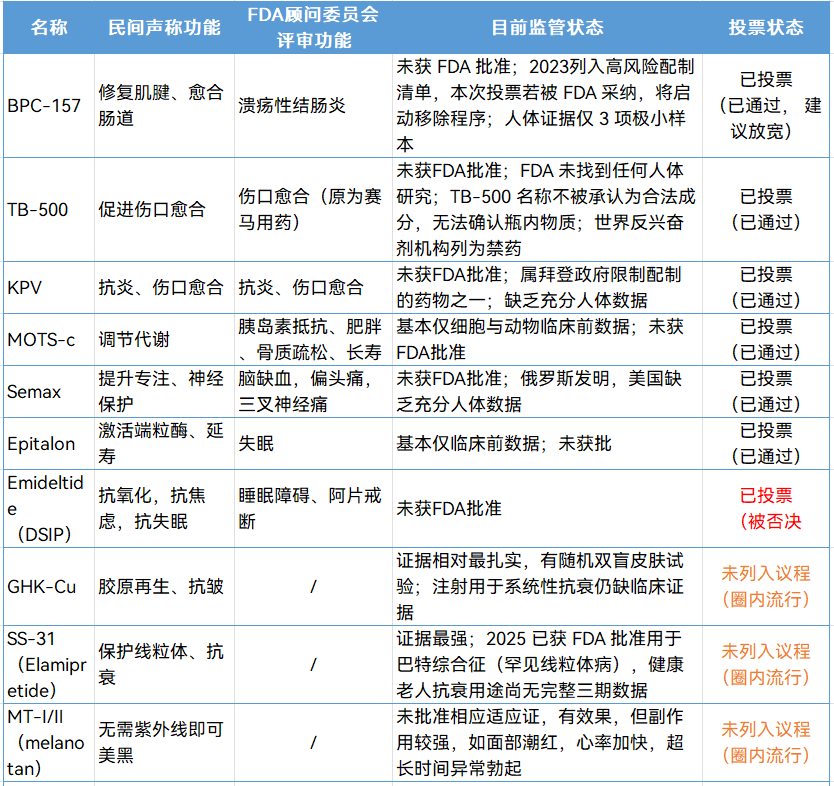
Many of these peptides, along with others that were not reviewed during this meeting, have not undergone the full range of clinical efficacy testing, manufacturing validation and toxicological studies.

According to materials disclosed by the FDA, the evidence supporting a more permissive approach remained limited even on the day of the vote. A white paper jointly published in May by ECRI and the Institute for Safe Medication Practices (ISMP) also warned that commercial demand was moving faster than clinical evidence, with insufficient data to support human use.

Before the committee voted on seven peptides, FDA career scientists had already recommended rejecting all seven.

Yet the final vote produced a very different outcome.


Why did this happen? At its core, the controversy reflects a clash between scientific judgment, financial interests and political influence.

A major change in the composition of the advisory committee

Peter Lurie, president of the Center for Science in the Public Interest and a former FDA official, has pointed out that reputable advisory committees typically exclude members with financial interests that could affect their voting decisions.

So who actually took part in this vote?

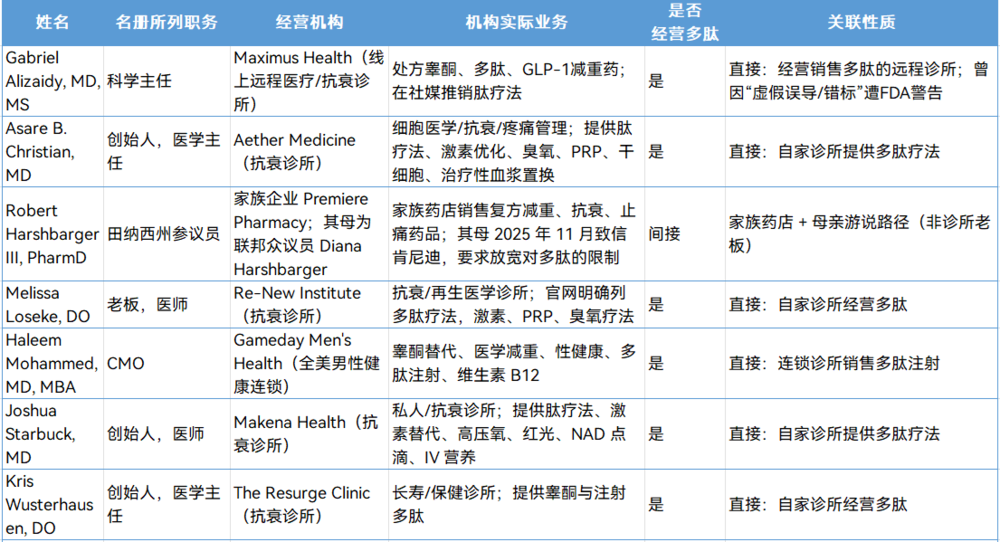
According to the FDA's website, the voting panel consisted of 12 members. At least eight had been appointed in 2026, and at least seven of the newly appointed members reportedly had connections to the peptide industry or had actively advocated for more permissive peptide policies.


FDA officials had raised concerns about potential conflicts of interest before the meeting. However, these warnings did not change the voting outcome.

Critics have therefore argued that Robert F. Kennedy Jr. effectively reshaped the committee by appointing members who shared his views.

Paul Knoepfler, a professor at the University of California, Davis School of Medicine, went further, commenting that the committee appeared to be a group capable of overturning the recommendations of FDA staff.


Political influence moved from behind the scenes into the spotlight

Robert F. Kennedy Jr., the U.S. Secretary of Health and Human Services, has openly described himself as a major supporter of peptides. He has pledged to end what he calls the FDA's "war on peptides" and has claimed that peptides helped him recover from injuries.

Some people in his circle also have commercial connections to the peptide market. Gary Brecka, who describes himself as a biohacker, sells peptides through his website. Mark Hyman, a functional medicine physician, is another prominent advocate of peptide use.

Although the Department of Health and Human Services (HHS) has maintained that the newly appointed committee members underwent ethics reviews, critics have questioned the extent of political influence behind the changes to the voting panel.

Political support has also come from Congress. Tennessee Senator Bobby Harshbarger, who is a pharmacist, and his mother, Representative Diana Harshbarger, have both supported peptides. Diana Harshbarger even wrote to the public and to Secretary Kennedy last year, urging the government to ease restrictions.

When scientists say the evidence is insufficient but influential political figures openly declare their support, the debate becomes about more than scientific data.

4. What Are These Peptides Claimed to Do, and How Strong Is the Evidence?


Supporters claim that peptides can help people achieve a darker tan, improve their health and build a better physique.

In bodybuilding and anti-aging circles, there is also an informal list of popular peptides that users often combine into so-called "stacks."

But when these claims are examined individually, the gap between marketing promises and scientific evidence becomes clear.


The contrast is striking: on one side are attractive claims; on the other is a much weaker body of supporting evidence.Note: MT-I/II, which is associated with tanning, was not included in the advisory committee vote. It is nevertheless another peptide with a controversial history. Readers interested in the subject can refer to our previous article, "The Pink Journey of a So-Called 'Barbie Drug'."For example, someone who injects BPC-157 and reports feeling "fantastic" two weeks later may be experiencing a placebo effect or other psychological influences, including the excitement of trying a new product. One or several positive personal experiences cannot establish that a substance is effective for the wider population.

Peptide injections may also involve significant safety concerns.

Infection risks

Injections made with inadequately sterilized products can lead to infections.

Potential tumor-related risks

Some peptides, including BPC-157, may promote angiogenesis, or the formation of new blood vessels. In theory, this could help injured tissues receive more blood supply and heal faster. However, tumor growth also depends on the development of new blood vessels.[7][8]

BPC-157 has also been reported to increase VEGFR2 expression. Elevated VEGFR/VEGFR2 signaling is observed in many human cancers.[8]

Other peptides, such as Epithalon, are theoretically capable of activating telomerase. However, many cancer cells also reactivate telomerase to achieve replicative immortality.

For these reasons, some oncologists have raised concerns that certain peptides could potentially promote cancer development. These concerns require further scientific investigation and should not be interpreted as proof that every peptide causes cancer.

Product contamination

The purity of peptides sold through unofficial channels can be highly questionable. The joint ECRI and ISMP white paper reported that the purity of some black-market peptide products could be as low as 5%.

Such products may contain significant levels of impurities, including endotoxins and heavy metals. In some cases, users may not even know exactly what they are injecting.

Adverse reactions

Peptides can interact with and stimulate the immune system, potentially triggering unwanted immune responses.

For example, thymosin alpha-1 is used as a vaccine adjuvant in certain countries to enhance immune responses.[10] However, when administered independently, it may also cause adverse reactions.

5. Are We Opening Pandora's Box by Opening the Regulatory Gate?


Given the FDA's influence on regulatory systems around the world, a more permissive approach to peptides in the United States could have consequences far beyond its borders.Hype Can Apparently Turn into Official RecognitionAs mentioned earlier, Health Secretary Robert F. Kennedy Jr. has publicly described himself as a major peptide enthusiast.

Joe Rogan, one of the most influential podcasters in the United States, has promoted BPC-157 on his podcast, claiming that it helped him recover from an injury. He has also included it in his publicly shared supplement routine.

Jennifer Aniston, the well-known Hollywood actress who starred in Friends, has also publicly stated that weekly peptide injections help her look "glowing."Note: Readers interested in Joe Rogan's supplement routine can refer to our previous article, "How Does America's Most Influential Podcaster Approach Anti-Aging?"The influence of celebrity endorsements should not be underestimated.

Kai Robbins, a longevity clinic operator, put it bluntly: if celebrities are using peptides and saying they work, the products will naturally become more mainstream and attract greater public attention.

Support from government officials and online influencers has already helped build a substantial following for peptides.

The advocacy group Save Peptides collected nearly 10,000 signatures calling for restrictions to be eased. Reddit has also become a popular place for users to compare prices and exchange information about peptide products.

Before the vote, the FDA invited public comments on the issue, further fueling public interest. The agency ultimately received more than 1,900 submissions.

The outcome even surprised Ed Lee, the petition organizer and co-founder of the Clinical Peptide Society. He reportedly said he did not know how to put the genie back in the bottle.

The public can easily hear influencers' microphones, but far fewer people understand randomized, double-blind clinical trials. In health-related debates, public opinion can sometimes partially take the place of scientific evidence.

Bypassing the Regulatory Process May Be Easier Than Expected


FDA career scientists recommended rejecting all seven peptides, and most committee members with academic backgrounds also voted against them.

But their opposition was not enough.

If a committee has enough members who support a particular position, its voting outcome can change. Once the Secretary of Health and Human Services had made his support for peptides clear, newly appointed members were unlikely to be unaware of his position.

The regulatory threshold itself had not necessarily changed. Instead, critics argue, the people responsible for guarding it had changed.

FDA scientists may have underestimated how difficult it is to persuade those who set the rules, compared with persuading the scientific community.

Once the Gate Opens, an Unregulated Market May Be Harder to Control


Even before this vote, the misuse of peptides in the health and wellness market had already become a serious problem.

In July 2025, at RAADfest—the Revolution Against Aging and Death Festival, a longevity event held in Las Vegas—two women nearly died after receiving anti-aging peptide injections. The pharmacy association investigating the incident reportedly could not determine exactly what substances they had received or why they had become so seriously ill.

Health Canada has also issued specific warnings about popular peptides sold online, including BPC-157, CJC-1295, ipamorelin, TB-500 and retatrutide. The agency stated that online and social media claims about their anti-aging, weight-loss and injury-recovery benefits were not supported by sufficient evidence. It has also seized some of these products.

A similar trend can be seen on Chinese social media, where influencers increasingly discuss peptides. The products have already begun to find their way into the domestic market, often entering through overseas online purchases or being marketed as chemicals for research use, while being used in ways that fall into regulatory grey areas.

China's annual 3·15 consumer rights television program previously exposed illegal injectable products marketed as cosmetics, including peptide-related products such as "glucopolypeptides," which reportedly left users with severe facial damage. In 2026, local market regulators also investigated and penalized illegal injectable products containing peptide proteins.

In the United States, peptide injections purchased online reportedly cost around USD 300–600. Services offered by some so-called longevity clinics can cost several thousand dollars per month.

If a more permissive regulatory pathway develops, the market could attract even more consumers who do not fully understand the risks, alongside more businesses seeking quick profits.

When those in positions of authority are simultaneously supporters of a product and influential decision-makers over its regulation, public hype, commercial interests and political power can converge. The result can place evidence-based science in an increasingly difficult position: a substance may be declared promising before science has established whether it actually works.

A World in Which Science Is the Only Loser


Developing a medicine typically requires extensive clinical efficacy testing, manufacturing validation and toxicological studies. The process can take more than a decade on average.

Modern evidence-based medicine has taken more than a century to establish the principle that medical decisions should be guided by evidence rather than belief.

Today, however, a small number of influential people are attempting to turn that principle upside down through social media influence, commercial interests and political power.

More importantly, the problem reflected in this debate is not limited to the United States.

The three forces that can undermine evidence-based medicine—online hype, vested commercial interests and the will of those in power—are challenges faced by healthcare systems around the world.

When public attention, financial incentives and political influence begin to outweigh scientific evidence, the consequences extend far beyond the peptide market.


Related products

Tesamorelin Acetate Powder · Ipamorelin Powder · Retatrutide · Tirzepatide · Semaglutide · Liraglutide · Cagrilintide · CJC-1295 (Tesamorelin/GHRH Analog). Every lot ships with HPLC purity, mass-spectrometry confirmation and a batch COA. Cold-chain packing is available where the destination requires it.

Related News
Leave me a message
X
We use cookies to offer you a better browsing experience, analyze site traffic and personalize content. By using this site, you agree to our use of cookies. Privacy Policy
RejectAccept